Commencement of the de Volkhuisvesting programme
Updated: Dec 31, 2023
1926

Photo of housing type 0 by Volkhuisvesting in Kampong Mlaten of Karrenweg (nowadays, Dr. Cipto Street)
Source: LOCALE TECHNIEK: Teschnisch Orgaan van de Vereeniging voor locale belangen, Ie JAARGANG No. 1/2. Uitgave JAN./APRIL 1932.
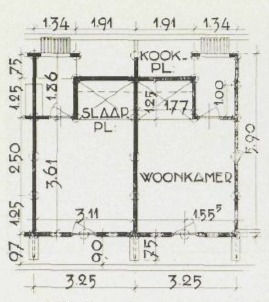
Floorplan of housing type 0 by Volkhuisvesting
Source: LOCALE TECHNIEK: Teschnisch Orgaan van de Vereeniging voor locale belangen, Ie JAARGANG No. 1/2. Uitgave JAN./APRIL 1932.
Previous sequence of events:
1907 - A renowned city doctor, Willem T. de Vogel alongside his colleague Hendrik F. Tillema a pharmacist and member of the Semarang City Council, came up with the idea of Kampogverbetering (Kampong improvement). The idea was prompted by the poor condition of the neighbourhoods and kampongs in Semarang, which led to an outbreak of dysentery.
Despite the lack of support from the government, the idea was realised by purchasing a plot of land using private funds and then collaborating with KCP de Bazel to design a settlement on the hillside south of Semarang. It was this idea and self-help programme that underpinned the development of Heuvelterrein into Nieuw Tjandi and the initiation of the Volkshuisvesting programme in the following years.
Late 1917 - Addressing the worsening conditions of the settlement, five gentlemen from Semarang; Mr. D. de Jongh Wzn (The City Mayor of Semarang 1916-1927), V. Jockin, Th. Karsten, Th. Vreede and D.J.A. Weterveld applied a circular letter to Sociaal-Technische Vereening van demokratische ingenieurs which is headquartered at The Hague, that stated a request to establish a branch in the Dutch East Indies. This act intended to raise national awareness of the settlement issue and other related sub-issues; social issues, health issues, and public welfare issues.
20 Desember 1917 - The founding meeting of the Dutch-East Indies branch of the Sociaal Technische Vereeniging was held at the residence of the Mayor of Semarang at that time; D. de Jongh. The result of that meeting was the appointment of Mr. V. Jockin as Secretary of the temporary board in Semarang.
May 1918 - During the 8th Decentralisation Congress held in Batavia, D. de Jongh, Burgemeester/Mayor of Semarang (1916-1927) presented a pre-conference report that discussed recommendations to the Colonial Government regarding the alleviation of housing problems at the regional/municipal level. The recommendations included:
The necessity of loans and grants from the central government to the municipalities;
The importance of keeping land prices low through municipal ownership of land;
Imposition of tax on land and not buildings that are built;
The imposition of tax on land that has not been built at a relatively higher rate compared to land that has been built;
The necessity to control land speculation;
The need to create an expansion plan that indicates suitable land for housing.
23 September 1918 - A meeting of the members of the S. T. V. was held at the Pondok Building, Pendrikan, Semarang. During the meeting, Dr L. A. Krol presented some of his theses on the current outbreak in Central Java and, if no immediate action is taken, pandemic conditions could occur in Central Java, and Semarang altogether. Another important point made at the event was the ineffectiveness of the government's policies, which led to the recommendation for the amendment and expansion of Staatsblad 1916 No. 656 (delegation of implementation to each regional head for the control of infectious animal diseases in livestock and buildings that become rat nests), as well as the enactment of the Housing Act (Woningwet).
1922 - Thomas Karsten designed a housing plan for the volkshuisvesting program.
18 April 1922 - The first national housing congress is held in Semarang, initiated by the Social Technische Vereeniging of the Dutch East Indies. The congress decided to authorise the Sociaal Techinische Vereeniging by members and participants of the congress consisting of members of the Dutch East Indies parliament to obtain the right to oversee and regulate public housing together with the central government through recommendations.
In addition, the congress also called for opposition to the draft Fleet Act (Vlootwet) 1922, which contained plans for a large budget for the Dutch East Indies to procure various equipment and strengthen military defence. The opposition was expressed through the oration of Westerveld (one of the S. T. V. council members) who thought that the 1922 Fleet Bill had the potential to bring misery to the people of the Dutch East Indies, and Westerveld argued that a large nominal budget should be allocated to overcome existing problems in the Dutch East Indies; one of which was the availability of housing for the Dutch East Indies community at large.
After the congress was over, the Social Technische Vereeniging visited kampungs in Semarang city.
2-3 August 1925 - The second National Housing Congress or Het Volkshuisvestingcongress was held in Semarang. The congress was chaired by Sociaal Technische Vereeniging President J. J. G. E. Ruckert, who was accompanied by Dr A. Rivai.
1925 - The Dutch East Indies government established N.V. Volkuisvesting which had a working area at the municipal level with the main task of acquiring land and attracting capital for housing provision.

Comments