Banknotes started to be used in transactions, distributed by De Javasche-bank in Semarang
Updated: Oct 22, 2023
1859
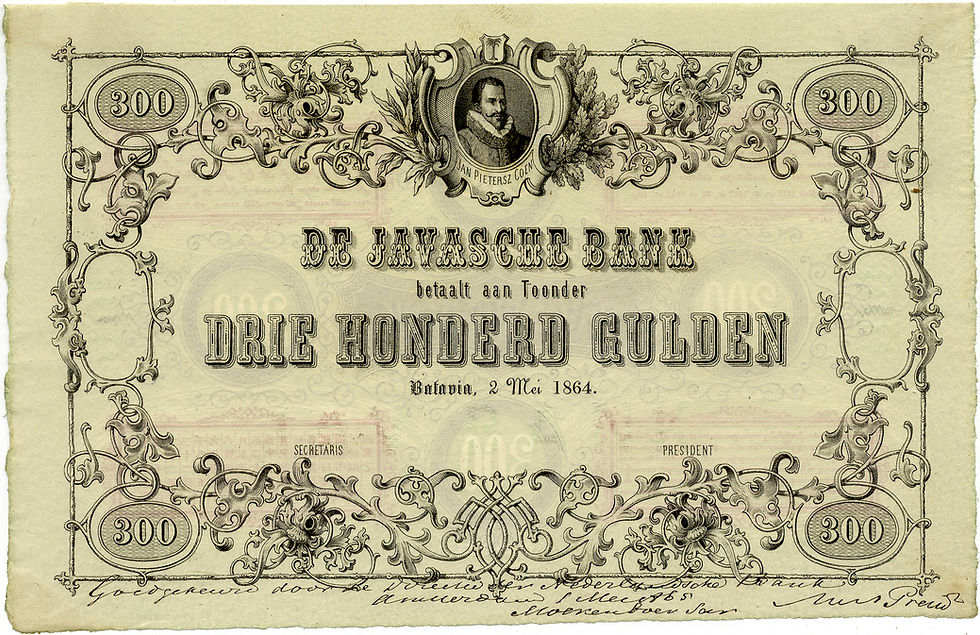
De Javasche Bank note issues, January 1864 – April 1895, printed by Joh. Enschede en Zn.
Source: papermoney-indonesia
In 1859, De Javasche Bank began to circulate Gulden's banknotes as a valid medium of exchange, one year right after De Javasche Bank obtained octrooi right to distribute banknotes.
Related events:
24 January 1828 - De Javasche Bank was established on 24 January 1828 as a circulation bank based on Staatsblad 1828 no.1 under Governor-General of the Dutch East Indies, Leonard Pierre Joseph burggraaf du Bus de Gisignies (1 March 1780 - 31 May 1849).
26 April 1828 - De Javasche Bank was granted octrooi rights by the Dutch East Indies Government based on Staatsblad 1828 no.34 in the form of power to issue securities, assignment letters, warrants, and receipts. However, in the issuance of these documents, De Javasche Bank was still subject to stamp duty in accordance with Ordinance Article 34 dated 16 October 1817 (in Staatsblad 1817 no.50).
13 June 1828 - De Javasche Bank's octrooi rights were strengthened when Staatsblad 1828 no.49 was published. De Javasche Bank is permitted to issue bonds and debentures with or without security.
17 Juli 1837 - Octrooi rights granted to De Javasche Bank prolonged every 10 years. De Javasche Bank's octrooi rights on the transaction were extended from 1 April 1838 to 1 March 1848 based on Gouvernements besluit no.1 dated 17 July 1837.
April 1858 - Based on the Governor General of the Dutch East Indies Decree dated 28 March 1858 no.5, De Javasche Bank obtained octrooi rights from April 1858 to March 1860. In these decrees, there were changes to the articles in the Staatsblad 1848 no.12, one of them was Article 27 which explained that De Javasche Bank had the power to issue banknotes worth 1000 gulden, 500 gulden, 300 gulden, 200 gulden, 100 gulden, 50 gulden, and 25 gulden which could be used as legal tender.

Comments