Geger Pecinan movement in Semarang
Updated: Dec 30, 2023
1740-1743
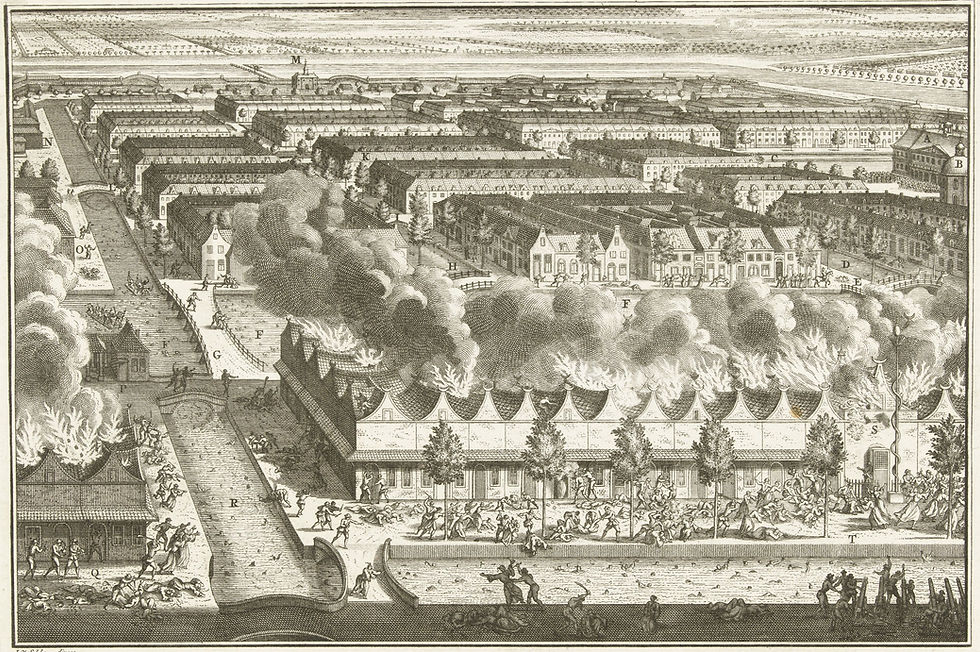
Geger Pecinan occurred in Batavia and also appeared in Semarang dan Kartasura
Source: Jacob van der Schley, 1761 - 1763 [rijkmuseum]
There was the Geger Pecinan movement as a response to the Chinese community massacre in Batavia-Semarang then several important VOC posts were besieged by Chinese troops, including Vijfhoek Fort and Europeesche Buurt in Semarang. The movement in Semarang was led by Soen An Ing (or locally: Sunan Kuning)
April 1741 - The Chinese who had heard the news of the massacre in Batavia began consolidating their forces in Tanjung Welahan (south of Pati City) and prepared to take revenge against the Europeans under the leadership of Sing Seh/Sing Kekh. The troops of the Chinese Laskar at the new base; Tanjung Welahan reached 1,000 troops, and began a movement to attack VOC posts on the east-north coast of Java, with the main objective of attacking the VOC headquarters in Semarang.
The Chinese militia movement began by cutting off the rice supply distribution route for Semarang. Bartholomeus Visscher, the VOC commander for Semarang, sent 540 troops to attack Tanjung Welahan but failed. Semarang also sent 15 soldiers to strengthen the defences of the Jepara post and gave an order to the Jepara and Rembang garrisons to recruit local forces from Bugis, Makasar, and Balinese mercenaries.
May 1741 - Ang Khoo, a Chinese Kapitan of Semarang and the entire Chinese community of Semarang, as well as the merchants residing in Semarang, who had originally sworn allegiance to the VOC, left Semarang. Knowing this, Visscher ordered the arrest of Ang Khoo and a search of his residence. During the search, a considerable amount of gunpowder, cannonballs and small cannons were found. Ang Khoo tried to make a defence, but to no avail, so Visscher ordered Ang Khoo to be executed.
June 1741 - Semarang was besieged by Chinese militia who were able to carry out guerrilla attacks and small-scale military movements through skirmishes, as well as the burning of several fort walls. The VOC sent a force of 46 Europeans and 146 Bumiputera, assisted by local Javanese soldiers, to repel the Chinese militia. However, the Javanese troops defected in the middle of the battle. The Regent of Semarang at the time, Adipati Sastrawijaya, secretly destroyed the VOC's artillery supplies and after the secret mission was successful, the Duke and his troops disappeared.
Towards the end of June 1741, Commander Vischer lost his sanity, due to pressure from the Chinese militia and Pakubuwana II, who had promised to help defend Semarang, turned to favour the Chinese militia. As a result, Visscher was replaced by Abraham Roos, who arrived with 170 soldiers and another 250 soldiers (who would be coming to Semarang shortly) from Batavia.
July 1741 - It was the Chinese militia that launched a further movement by barricading and cutting off contact with VOC ships anchored in Semarang waters. In addition, the Chinese militia also reinforced the barricades on the southern side of the city, leaving Semarang completely under a state of lockdown. The VOC's central authority in Batavia then rushed to send 1,400 new troops, with 200 European troops and 1,200 native troops from Makasara, Ternate and Sumbawa under Major Nathaniel Steinmetz.
Mid-September 1741 - Abraham Roos, who succeeded Bartholomeus Visscher, submitted his resignation as gezaghebber (head of the government) due to bad relations with Major Nathaniel Steinmetz. The interim Governor-General Johannes Thedens (1741-1743) strongly disapproved of Roos' decision given the ongoing war. However, since most of the Council of the Indies agreed to the request, Roos' resignation was finally granted.
Steinmetz was then appointed temporary gezaghebber, and the VOC authorities in Batavia sent additional troops to strengthen Semarang's defences. The first reinforcements came to Semarang under the leadership of the great Kapitan Gerrit Mom with 800 troops who had just completed a successful campaign against a rebellion in South Sulawesi, and at the end of November 1741, a second reinforcement arrived with 2,270 men from the troops on leave to return to the Netherlands.
Members of the Council of the Indies (Raad van Indie) were beginning to realise that Semarang was in a precarious state, and that immediate action was required. The Council of the Indies felt that the presence of a gezaghebber alone would not solve the problems at hand, as a result, the Council of the Indies decided to form a special Committee with the main task of taking command of the operation to restore the security of Semarang. The idea was not easily accepted by the members of the Council of the Indies, so a heated debate had to be held to realise the idea that some members of the Council of the Indies considered most efficient until finally Hugo Verijsel and Jan Herman Theling were sent to Semarang as members of the Special Committee that were finally formed.
17 October 1741 - The Special Committee for the Semarang Recovery Operation finally arrived in Semarang and immediately gave orders to the regents, Patih Natakusuma, and the Sunan Pakubuwana II to turn the tide of battle and assist the VOC against the Chinese militia, with Hugo Verijsel guaranteeing pardons and favourable treatment from the VOC for anyone who obeyed his orders.
November 1741 - By this time, Semarang was besieged by 3,500 Chinese militia troops and 20,000 Javanese troops from Pakubuwana II, in addition to 30 cannons located around the Semarang fortress. The VOC, which at the time only had approximately 3,400 soldiers defending the Semarang garrison, was able to break the siege of the Chinese militia troops resulting in most of Pakubuwana II's troops fleeing when they saw the defeat of the Chinese militia camp.
After successfully taking over and securing Semarang, the VOC immediately travelled to Jepara to take back the post that had fallen into enemy control. However, due to bad weather and limited logistics, the VOC was unable to launch a major military operation and handed over military operations in the inland area to the VOC's allies, the troops of Cakraningrat IV.
Most of the Chinese troops were killed, including the leaders of the Chinese militia movement, Sing Se and Sabuk Alu. Khe Sepanjang once again fled towards Pati with the remnants of his army. After the area around the Semarang fortress was freed from the siege of the Chinese militia, the VOC also attacked the Chinese fortresses around Semarang.
Pakubuwana II attempted to change the policy he had adopted and resorted to what some of the VOC-hating Javanese courtiers considered an embarrassment: begging for forgiveness. The VOC, then still quite weak militarily, decided that it would be wise to re-establish friendship with Mataram, although suspicion and wariness of the king remained.
March 1742 - The VOC sent seven troops under the command of Captain Johan Andries Baron von Hohendorff to make the dangerous journey to the Kartasura court and conduct negotiations. The negotiations resulted in the decision that the VOC was willing to pardon Pakubuwana II, but to avoid unnecessary fighting the VOC demanded guarantees with Prince Ngabei Loringpasar, the eldest son of patih Natakusuma, and Pringgalaya as prisoners of honour. Pakubuwana II was forced to agree to the proposition, but Prince Loringpasar was replaced by Ratu Amangkurat, for health reasons.
Unwilling to have his son taken hostage, the patih took the initiative to give the impression of loyalty to the VOC. Verijsel, who had previously ordered Natakusuma to be on standby and maintain the security of the Kartasura -Demak route, by clearing the Chinese militia still occupying the area, eventually carried out a fake attack on the Chinese militia - the sick and wounded Chinese were killed, while those still in good health were allowed to escape. Natakusuma then travelled on to Kartasura to find and rescue his son. Arriving in Semarang, Natakusuma then wrote a letter stating his intention to meet Verijsel.
17 June 1742 - Instead, Verijsel arrested Natakusuma during a stopover at the Semarang fortress, and this decision was not a form of betrayal by Verijsel, given that two hours after Natakusuma's arrest, Pakubuwana II sent a letter confirming Natakusuma's arrest.
Pakubuwana II's decision to secure power behind the VOC signalled the end of the battle at the Semarang fortress. In addition, Pakubuwana II's hasty and irresponsible decision led some local Javanese rulers to disown the Susuhunan. Finally, some of the local rulers/princes who still supported the Chinese militia movement appointed a young, 12-year-old prince, Raden Mas Garendi; the grandson of the exiled king of Mataram in 1708 (Amangkurat III), as the new leader.
Raden Mas Garendi is mentioned in several secondary sources (Rickleffs. 1983:281; Setiono, 2008:156; and Hall, 1981:358) as being chosen by the opposition Javanese rulers, and given the title Sunan Kuning to then start a movement against the Pakubuwana II - VOC alliance by attacking Kartasura in late June 1742.
Post- the Chaos in Semarang 1741:
1742 - Vijfhoek fort started to be demolished in part
1743 - The city wall began to be built and is expected to be finished or partially finished in the 1760s.
Dutch carried out racial segregation; ethnic Chinese settlements were relocated in the current position of Chinatown, located south of the Dutch residential city, between the Fortress and the Semarang riverbank, known as the Pekojan area. At first, the Chinese community settled and occupied several different settlements, including Kampung Welahan, Peterongan, Kaligawe, Mrican, Gedong Batu, Bustaman, etc.
1821 - 1835 - A Pass or activity permit policy was introduced for the Foreign Eastern Community (Vreemde Oosterlingen), especially for the Chinese community, which was called Passenstelsel. The regulation obliges the Chinese community to have and carry a road pass card when carrying out activities outside the designated area. If the regulation is violated, imprisonment and fines will be imposed.
Three decades of the early 19th Century (1835 - 1844) - The new racial segregation was carried out by the Dutch in this year; the implication of localisation (Wijkenstelsel) that forced the Chinese community to live in concentration camps or Kampung Pecinan and prohibited the Chinese community to settled in areas outside Pecinan. Initially, the Chinese Community settled and occupied different areas in Semarang, including Kampung Welahan, Peterongan, Kaligawe, Mrican, Gedong Batu, Bustaman, Kampung Melayu, Pedamaran, Pekojan, and Kranggan. The position of the Pecinan is placed in the south of the Dutch residential city; currently between the Fort and the edge of the Semarang River. This was solely intended to facilitate the control of mass movements - "onder het berijk vans ons geschut" meaning "within firing range of our cannons", was one of the main considerations in the Colonial Government's choice of concentration camp locations for the Chinese.
The cause of Chinese resistance:
1740 - It is estimated that in the mid-1740s, a residence permit policy was implemented for groups of foreign Eastern communities; especially ethnic Chinese who had lived in Batavia, the residence permit was called "permissiebriefjes". A regulation that was implemented in response to the problem of the increasing number of immigrants from China who came and sought their fortune in Batavia; which from the perspective of Europeans caused un-conducive conditions in the city, besides that in the range of the 18th century there was an outbreak of dysentery in Batavia, and population density was one of the scapegoats of various other factors that could cause the dysentery epidemic at that time.
These rules and policies were implemented by the VOC through the screening of Chinese people based on hairstyle. Chinese men who wore their hair in the old style and had settled in Batavia before 1683 were allowed to stay after registering themselves to the government. Whereas the Chinese men who wore their hair in the Manchu style (a regime in China that had been in power since 1644); with a distinctive style of being shaved bald at the front, were assumed to be new migrants and obliged to register within two week of their arrival in Batavia or from the time the regulation was enacted. All Chinese that arrived from China had to leave Batavia as soon as possible, otherwise, they would be confined and chained until the departure of the Jung ship in the following year.
According to the VOC's perspective, the implementation of this policy was considered the most solutive yet relevant in addition to the problem of the availability of employment for Chinese people. In addition, the VOC did not want to implement steps that were considered too repressive and strict, given the significant role of the Chinese community in trade, so there was a concern in the government's mind that if the implemented policy was deemed too repressive towards the Chinese community, it would have a direct impact on the sluggishness of the trade activities and the scarcity of food and trade commodities.
25 July 1740 - A resolution was passed by the government on the proposal of Van Imhoff (Governor-General of Ceylon 1736-1740; Governor-General of Batavia 1743-1750). It ordered all judicial officers and the commissioner for Inlander affairs, Ferdinand de Roy, to round up all suspicious wandering Chinese, whether they had a residence permit or not. The main purpose of these round-ups and arrests was to examine the livelihoods of the Chinese, and if there were Chinese who did not have livelihoods that were deemed suitable, they would be sent to Ceylon (Sri Lanka).
On the side of another section of society; the Chinese community, rumours emerged and spread that the Chinese "exiles" would not be transported to Ceylon (Sri Lanka), but would be thrown out of the ship on the high seas and drowned horribly. As a result, many Chinese chose to go into hiding, causing a halt to trade and food distribution.
26 September 1740 - News of the massive Chinese mobilisation reached the Council of the Indies. Vermeulen thought it unnecessary for the Council of the Indies to make a fuss about the uprising. The Europeans considered the Chinese rebellion and reports of crowds at Batavia outposts to be a laughable joke ("genoeschsaem gelachen"). But not Adriaan Valckenier (Governor-General of the VOC in Batavia 1737-1741), who took it seriously and was always keen to proceed to harsher measures, despite the opposition led by Van Imhoff.
04 October 1740 - The Council of the Indies finally decided to make an "extraordinary move" or "extra ordinaire bewegingen" by strengthening the guard around the fort at night.
07 October 1740 - Alarming reports from the Europeans (VOC) of hundreds of Chinese lined up and ready to fight were met with the decision to take up arms and attack the "rebels". A massacre of the Chinese community by the VOC ensued and eventually triggered a resistance movement called Geger Pecinan or Chinezenmoord.

Illustration of the situation in Ommenlanden in 1740; where Chinese people killed Dutch soldiers (left) and in Batavia, where urban Chinese were "als' willooze lammeren' kueteb afslachten" or "slaughtered like boneless lambs" (right).
Source: Atlas van Stolk. Catalogus der historie-, spot- en zinneprenten betrekkelijk de geschiedenis van Nederland, obtained from Dharmowijono, W. 2009, "Van koelies, klontongs en kapiteins : het beeld van de Chinezen in Indisch-.
Nederlands literair proza 1880-1950" University of Amsterdam.

Comments