Champagne-Style Bottle
- Museum Kota Lama
- Oct 10, 2023
- 3 min read

Updated: Oct 15, 2023
Date: Mid 19th Century

One of the findings from the excavation conducted by the Balai Arkeologi Yogyakarta (Archaeological Centre of Yogyakarta now known as BRIN) in 2014 at the locus of Kota Lama Semarang. Based on the identification that has been taken, this bottle has intact parts with dimensions of 30 cm long; and the diameter of the "lipping" part is 3 cm, and there is a horizontally circular ring (finishing string) with a height of approximately 1 cm and has a diameter of 3.8 cm. The neck is cylindrical; round and long, with a diameter of 3.8 cm and a length/height of 12.5 cm. The shoulder of the bottle is vertically relatively sloping with the widest shoulder diameter of 9.24 cm. The body of the bottle is horizontally rounded with a diameter of 9.56 cm and has a height of 17.5 cm. At the base or edge of the base, there is a concave "kick-up" or "push-up" feature with a depth of approximately 5.2 cm, in addition, there is also a mamelon or protrusion that juts out.

Morphologically, this bottle is strongly suspected to be a champagne bottle or better known as a Champagne-style Bottle. The champagne bottle style is one of the alcoholic beverage bottles commonly found in the mid-19th century to early 20th century in colonial sites. This was based on the physical characteristics of the bottle with the presence of a finishing string near the lip of the bottle as a support or place to place the cork, as well as a kick-up complete with mamelon and the thickness of the glass on the body and shoulder; some of these characteristics are very closely related to bottles used as containers of carbonated alcoholic beverages such as champagne and beer.
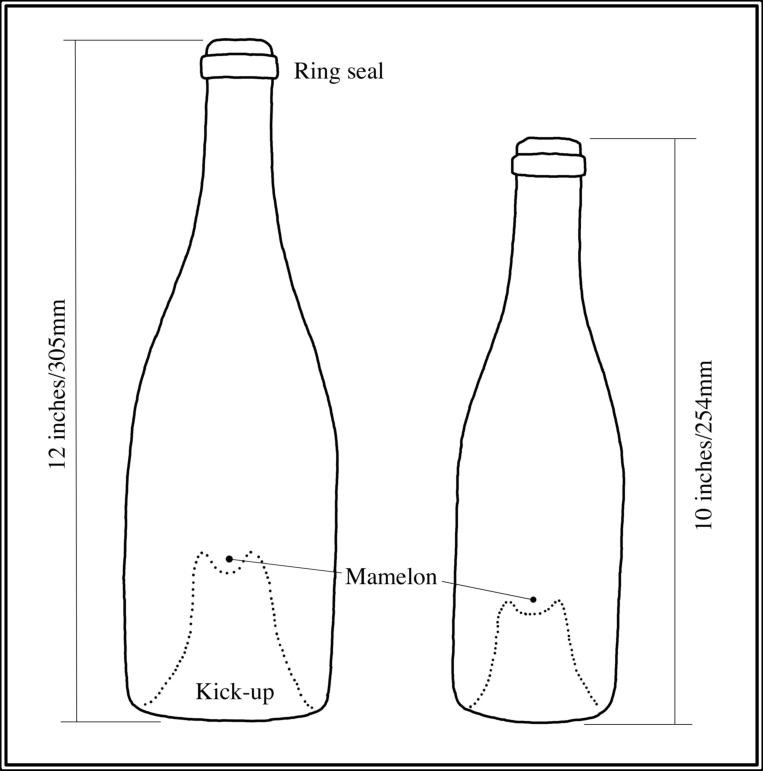
In terms of dating, this collection is strongly suspected to be a champagne bottle produced in France during the 1900s-1920s. Although it has not been possible to identify the brand of the product bottled in this collection, based on comparisons with the types of bottles commonly found in sites during the colonial period, it is thought to have similarities with champagne bottles under the Pommard brand (1900-1905s), or Moet et Chandon (from the 1750s to the present).
The presence of the "kick-up" and mamelon features at the base suggests that the bottle was manufactured using free-blown or blown techniques, with tooled and turn-molded finishing methods. The ring seal below the lip of the bottle indicates that the manufacturing process is thought to have been carried out after the bottle manufacturing process was completed using the same materials as the bottle, and is an intact feature or not a separate addition using additional materials.
Tooled Finishing
Tooled finishing, is a finishing method in bottle making that is usually done after the free-blown technique has been adopted. In terms of the process, after the air pipe is removed from the neck of the bottle, the finishing is shaped and made smooth and precise by reheating the end of the neck (without adding material) and manually processed using a hand compression tool to form the "lipping" or "finishing".

Regarding the technical use and application of the finishing shaping tool (illustration on the side), among others:
After the blowing forming process equipped with a turn-mold has been completed, the tool is inserted into the neck of the bottle and then rotated (or the bottle is rotated with the tool) while squeezing the jaws to form a finish according to the desired shape. It should be noted that the shape of the finish may have been used to finalise a finish that was previously patterned by hand.


Comments